Showing posts sorted by relevance for query birds. Sort by date Show all posts

Thursday, March 24, 2011

Birds Illusion - Bird Pattern

This repeating pattern of an ornithological variety contains a number of birds - but exactly how many of each color are there ?

Birds Illusion - Bird Pattern


READ MORE - Birds Illusion - Bird Pattern

Birds Illusion - Bird Pattern

This repeating pattern of an ornithological variety contains a number of birds - but exactly how many of each color are there ?

Birds Illusion - Bird Pattern


READ MORE - Birds Illusion - Bird Pattern

Saturday, May 26, 2012

Man in canoe or man in birds mouth?

Man in canoe or man in birds mouth?

Man in canoe or man in birds mouth?

Man in canoe or man in birds mouth?
READ MORE - Man in canoe or man in birds mouth?

Tuesday, April 17, 2012

Birds Optical Illusion

Some people may react to this anomalous motion optical illusion and if you think you might be one of these people it is important to read the caution at the top of this page prior to proceeding.

The birds in this image appear to fly in a counter-clockwise direction.

Pyramid Optical Illusion

Herman J. Verwaal
copyright 2005
used w/permission


Herman has a large collection of optical illusions that he has created over time. He has generously allowed me to feature a few of his pieces here. This is the first I chose to show because I love the motion of the birds. His illusions run the gambit and I will be showing you more of his excellent Trick-Art in the future.

Thank you Herman for allowing me to share this with my viewers.
READ MORE - Birds Optical Illusion

Tuesday, October 11, 2011

Flying Birds Illusion

Here is a beautiful view of artist who shows the many possibilities offered to the illusion of rotation. It is the combination of repeated only 4 colors that creates the illusion in our brains.

Indeed, removing the alternating colors, the effect disappears immediately.

Flying Birds Illusion
READ MORE - Flying Birds Illusion

Monday, December 12, 2011

Face with Tree & Birds | Optical Illusion

Amazing Illusion Made By Tree & Birds

READ MORE - Face with Tree & Birds | Optical Illusion

Thursday, April 28, 2011

Colorful bird illusion | Hidden bird illusion

This repeating pattern of an ornithological variety contains a number of colorful and hidden birds - but exactly how many of each color are there?

Colorful and hidden bird illusion
READ MORE - Colorful bird illusion | Hidden bird illusion

Thursday, March 24, 2011

11 Face Optical Illusion - Scary Optical Illusion

What you can see in it?
some faces of man, women, birds and some of the animals.
11 faces are in it
Can you find out them?
11 Face Optical Illusion - Scary Optical Illusion

READ MORE - 11 Face Optical Illusion - Scary Optical Illusion

Monday, December 12, 2011

Face with Tree & Birds | Optical Illusion

Amazing Illusion Made By Tree & Birds

READ MORE - Face with Tree & Birds | Optical Illusion

Thursday, March 24, 2011

11 Face Optical Illusion - Scary Optical Illusion

What you can see in it?
some faces of man, women, birds and some of the animals.
11 faces are in it
Can you find out them?
11 Face Optical Illusion - Scary Optical Illusion

READ MORE - 11 Face Optical Illusion - Scary Optical Illusion

Thursday, May 27, 2004

M.C. Escher Bio

Maurits Cornelis Escher (Leeuwarden, June 17, 1898 – March 27, 1972 in Laren) was a Dutch artist most known for his woodcuts, lithographs and mezzotints, which tend to feature impossible constructions, explorations of infinity, and tessellations.

Youth

Maurits Cornelis, or Mauk as he was to be nicknamed, was born in Leeuwarden (Friesland), the Netherlands. He was the youngest son of civil engineer George Arnold Escher and his second wife, Sarah Gleichman. In 1903, the family moved to Arnhem where he took carpentry and piano lessons until the age of thirteen.

From 1912 until 1918, he attended secondary school; though he excelled at drawing, his grades were generally poor, and he had to repeat the second form. Later, from 1919, Escher attended the Haarlem School of Architecture and Decorative Arts; he briefly studied architecture, but then made a switch to decorative arts, studying under Samuel Jesserun de Mesquita, an artist whom he would remain in contact with until de Mesquita, his wife and son were murdered by the Nazis in early 1944. In 1922, Escher, having gained experience in drawing and particularly woodcutting, left the school.

Marriage and later life

Escher travelled to Italy regularly in the following years. It was in Italy, too, that he first met Jetta Umiker, the same woman who he married and made his vows to in 1924. The young couple settled down in Rome after they had been married and stayed there for just over ten years until 1935; when the political climate under Mussolini became unbearable, the family moved to Château-d'Oex, Switzerland. They stayed here for two years.

Escher, however, who had been very fond of and inspired by the landscape in Italy, was decidedly unhappy in Switzerland, so two years later, in 1937, the family moved again, this time to Ukkel, a small town near Brussels, Belgium. World War II forced them to move for the last time in January 1941, this time to Baarn, the Netherlands, where Escher lived until 1970.

Most of Escher's better-known pictures date from this period; the (sometimes) cloudy, cold, wet weather of the Netherlands allowed him to focus entirely on his works, and only in 1962, when he had to undergo surgery, was there a time when no new images were created.

Escher moved to the Rosa-Spier house in Laren in the northern Netherlands in 1970, a retirement home for artists where he could have a studio of his own. He died at the home on the 27th of March 1972, he was 73 years of age. Escher and Umiker had three sons.

Works

Well known examples of his work include Drawing Hands, a work in which two hands are shown drawing each other, Sky and Water, in which plays on light and shadow convert fish in water into birds in the sky, and Ascending and Descending, in which lines of people ascend and descend stairs in an infinite loop, on a construction which is impossible to build and possible to draw only by taking advantage of quirks of perception and perspective.

Escher's work has a strong mathematical component, and many of the worlds which he drew are built around impossible objects such as the Necker cube and the Penrose triangle. Many of Escher's works employed repeated tilings called Tessellations. Escher's artwork is well-liked by scientists, especially mathematicians who enjoy his use of polyhedra and geometric distortions. For example, in Gravity, multi-colored turtles poke their heads out of a stellated dodecahedron.

One of his most notable works is the piece Metamorphosis III, which is wide enough to cover all the walls in a room, and then loop back onto itself. That was, of course, the intention.

Selected list of works
  • Trees, ink, (1920)
  • St. Bavo's, Haarlem, ink, (1920)
  • Flor de Pascua (The Easter Flower), woodcut/book illustrations, (1921)
  • Eight Heads, woodcut, (1922)
  • Dolphins (Dolphins in Phosphorescent Sea), woodcut, (1923)
  • Tower of Babel, woodcut, (1928)
  • Landscape at Abruzzi, scratch drawing, ink and chalk, (1929)
  • Street in Scanno, Abruzzi, lithograph, (1930)
  • Castrovalva, lithograph, (1930)
  • The Bridge, lithograph, (1930)
  • Palizzi, Calabria, woodcut, (1930)
  • Pentedattilo, Calabria, lithograph, (1930)
  • Atrani, Coast of Amalfi, lithograph, (1931)
  • Ravello and the Coast of Amalfi, lithograph, (1931)
  • Covered Alley in Atrani, Coast of Amalfi, wood engraving, (1931)
  • Still Life with Spherical Mirror, lithograph, (1934)
  • Hand with Reflecting Sphere (Self-Portrait in Spherical Mirror), lithograph, (1935)
  • Inside St. Peter's, wood engraving, (1935)
  • Portrait of G.A. Escher, lithograph, (1935)
  • 'Hell' , lithograph, (1935) (copied from a painting by Hieronymus Bosch)
  • Regular Division of the Plane, series of drawings, (1936-196?)
  • Still Life and Street, woodcut, (1937)
  • Metamorphosis I, woodcut, (1937)
  • Day and Night, woodcut, (1938)
  • Cycle, lithograph, (1938)
  • Sky and Water I, woodcut, (1938)
  • Metamorphosis II, woodcut, (1939-1940)
  • Verbum (Earth, Sky and Water), lithograph, (1942)
  • Reptiles, lithograph, (1943)
  • Ant, lithograph, (1943)
  • Encounter, lithograph, (1944)
  • Doric Columns, wood engraving, (1945)
  • Three Spheres I, wood engraving, (1945)
  • Magic Mirror, lithograph, (1946)
  • Three Spheres II, lithograph, (1946)
  • Another World Mezzotint (Other World Gallery), mezzotint, (1946)
  • Another World (Other World), wood engraving and woodcut, (1947)
  • Crystal, mezzotint, (1947)
  • Up and Down, lithograph, (1947)
  • Drawing Hands, lithograph, (1948)
  • Dewdrop, mezzotint, (1948)
  • Stars, wood engraving, (1948)
  • Double Planetoid, wood engraving, (1949)
  • Order and Chaos (Contrast), lithograph, (1950)
  • Rippled Surface, woodcut and linoleum cut, (1950)
  • Curl-up, lithograph, (1951)
  • House of Stairs, lithograph, (1951)
  • House of Stairs II, lithograph, (1951)
  • Puddle, woodcut, (1952)
  • Gravitation, lithograph and watercolor, (1952)
  • Cubic Space Division, lithograph, (1952)
  • Relativity, lithograph, (1953)
  • Tetrahedral Planetoid, woodcut, (1954)
  • Compass Rose (Order and Chaos II), lithograph, (1955)
  • Convex and Concave, lithograph, (1955)
  • Three Worlds, lithograph, (1955)
  • Print Gallery, lithograph, (1956)
  • Belvedere, lithograph, (1958)
  • Sphere Spirals, woodcut, (1958)
  • Ascending and Descending, lithograph, (1960)
  • Waterfall, lithograph, (1961)
  • Möbius Strip II (Red Ants) woodcut, (1963)
  • Knot, pencil and crayon, (1966)
  • Metamorphosis III, woodcut, (1967-1968)
  • Snakes, woodcut, (1969)
References in popular culture
  • Matt Groening of The Simpsons made a reference to Escher in his Life in Hell comic. In Groening's parody of Escher's Relativity, cartoon rabbits fall down stairs at impossible angles. Groening would later reuse this joke in an episode of Futurama and as a couch gag on The Simpsons.
  • Similarly, a character on Drawn Together, an animated series on Comedy Central, was pushed down (and up, around, and back down) a flight of stairs modeled on Relativity.
  • In the Jim Henson movie Labyrinth Relativity is referenced again. The audience is again treated to an answer to the great question: what if somebody walks off the edge? The Escher estate was given acknowledgement in the credits for the film.
  • The bonus stages of the first Sonic the Hedgehog game, for the Sega Genesis/Mega Drive, feature an animated background of birds turning into fish, a reference to Sky and Water.
  • In Larry Niven's novel Protector, the protagonist builds a working model of Relativity using gravitational engineering.
  • The Psygnosis computer game Lemmings features a level called Tribute to M.C.Escher, although it doesn't sport Escheresque graphics. The Crystal Shard computer game SubTerra features a similarly named level, which does consist entirely of a repetitive pattern.
  • The early nineties rock group Chagall Guevara wrote a song called "Escher's World" which made many references to the impossible structures that can be found in Escher's work.


This article is licensed under the GNU Free Documentation License. It uses material from the Wikipedia article "M.C. Escher".
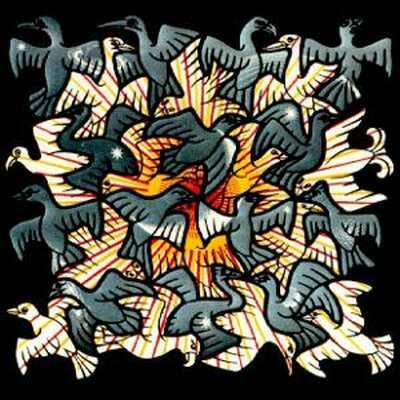
READ MORE - M.C. Escher Bio

Sunday, September 30, 2012

Hidden Water Animals Illusion

This is Amazing, there is lots of birds and fish but quite confusing to know actually what are there.

Hidden Water Animals Illusion
READ MORE - Hidden Water Animals Illusion

Thursday, March 3, 2005

Ascending and Descending

M.C. Escher is a great artist known for many drawings that feature impossible features.

From Wikipedia, the free encyclopedia.
Maurits Cornelis Escher (Leeuwarden, June 17, 1898 - Laren, March 27, 1972) was a Dutch artist most known for his woodcuts, lithographs and mezzotints, which tend to feature impossible constructions, explorations of infinity, and tessellations.

To Purchase this print click the picture.

The M.C. Escher work shown here is titled Ascending and Descending. His work has inspired many other artists over the years.

Wikipedia says the following about the works of M.C. Escher

Well known examples of his work include Drawing Hands, a work in which two hands are shown drawing each other, Sky and Water, in which plays on light and shadow convert fish in water into birds in the sky, and Ascending and Descending, in which lines of people ascend and descend stairs in an infinite loop, on a construction which is impossible to build and possible to draw only by taking advantage of quirks of perception and perspective.

Escher's work has a strong mathematical component, and many of the worlds which he drew are built around impossible objects such as the Necker cube and the Penrose triangle. Many of Escher's works employed repeated tilings called Tesselations. Escher's artwork is well-liked by scientists, especially mathematicians who enjoy his use of polyhedra and geometric distortions. For example, in Gravity, multi-colored turtles poke their heads out of a stellated dodecahedron.

One of his most notable works is the piece Metamorphosis III, which is wide enough to cover all the walls in a room, and then loop back onto itself. That was, of course, the intention.

One such inspired artist is Andrew Lipson. Andrew's page is currently forbidden. I am hoping that this is for a short duration. He has recreated various works of Escher's with Legos.

Copyright © A. Lipson 2002

Here is Andrew's version of Escher's "Ascending and Descending". This was joint work with Daniel Shiu. The full details regarding the construction can be found at the Ascending and Descending (back online) page. Since his page isn't accessible currently I'll let you in on a secret, in order for this construct to look real it had to be photographed from this precise angle. Again, please note that this image is copyright Andrew Lipson.

Andrew has recreated many Escher works. You can see some of them by searching Google, but as soon as his site is accessible again it is well worth a look because he shows angles and shares construction secrets that can't be found anywhere else.
READ MORE - Ascending and Descending

Thursday, April 14, 2005

Optical Illusions used by Plants and Animals

Optical illusions are survivor mechanisms for many plants and animals. We are all familiar with the chameleon. Presented here is the chameleon and other various examples of animals and plants using optical illusions to survive.


With its distinctive shape, ponderous movements and tiny eyes at the ends of conical turrets, the chameleon is an unmistakable reptile. Its ability to change colour is very well known, but this is not done to match its background as commonly believed - although that may happen coincidentally - but as a means of communication and to regulate body temperature.

If you surprise a chameleon, it will inflate its body, open its mouth to reveal it bright orange palette, hiss, and lunge forward. Such behavior is intended to surprise and confuse any attacker, giving the chameleon time to make an escape and utilize its superb camouflage against the foliage of a shrub or tree. Although slow-moving when under observation - they walk slowly to avoid detection - chameleons are actually able to scamper quite quickly when being pursued. The ferocious defensive behavior of these little lizards led to the ancient Greeks naming them 'Dwarf Lions' - 'Chamai leons'.

Twigs or Walking Sticks?


With special resemblance, animals use a combination of color, shape and behavior to help them appear like something in their habitat. They are simply mistaken for something else. The walking stick is a great example. This insect becomes almost invisible due to the shape of its body, its coloration and its slow movement. It looks and acts just like a twig on a bush or tree..

Plants or Rocks


Living stones also known as Lithops are plants that survive by looking like rocks in Southern Africa's deserts where they have become highly adapted to conditions of extreme heat and drought.
Twig or Caterpillar?


Which one is the caterpillar, and which is the twig? A close look at the bottom feet of the twig on the left shows that it is really a small caterpillar, which freezes itself into a rigid posture when predators are near! This ability enables it to escape detection by birds (but pays for its cleverness by occasionally having some other insect lay eggs on it by mistake).

Hiding as a Dead Leaf?


The katydid above hides on the forest floor. It has a perfect disguise... it resembles a dead leaf, veins and all!

For more examples of animals using camouflage go to this site.


The Duck Blind?

All of these examples above are nice but the ultimate example of an animal using an optical illusion is the duck in the below picture. Hunters have been using decoys for years it was just a matter of time until the ducks turned the table on them.


This last animal optical illusion was found over on Tasty Blog.
READ MORE - Optical Illusions used by Plants and Animals

Sunday, January 2, 2011

The Hidden Bird And Lion Illusion

This one is pretty easy but see if you can see the lion and a bird hidden amongst the Zebras and let me know how many Birds, Lions and Zebras did you found. Don't forget to comment me

The Hidden Bird And Lion Illusion
READ MORE - The Hidden Bird And Lion Illusion

Friday, October 26, 2012

What can you see?

What can you see? A woman's face? Two horses or three birds?


Or all three?
READ MORE - What can you see?

Tuesday, April 19, 2011

Sharp Billboard Slices Up Stupid Pigeons - Razor Blade Billboard


Annoying birds pooping all over your front porch? There is a billboard for that, the new extra-large razor blade will slice some in half and teach the others a valuable lesson. Also works on giant rocks raining down on your flowers.
READ MORE - Sharp Billboard Slices Up Stupid Pigeons - Razor Blade Billboard

Sharp Billboard Slices Up Stupid Pigeons - Razor Blade Billboard


Annoying birds pooping all over your front porch? There is a billboard for that, the new extra-large razor blade will slice some in half and teach the others a valuable lesson. Also works on giant rocks raining down on your flowers.
READ MORE - Sharp Billboard Slices Up Stupid Pigeons - Razor Blade Billboard

Wednesday, January 5, 2011

The Hidden Bird And Lion Illusion

This one is pretty easy but see if you can see the lion and a bird hidden amongst the Zebras and let me know how many Birds, Lions and Zebras did you found. Don't forget to comment me

The Hidden Bird And Lion Illusion
READ MORE - The Hidden Bird And Lion Illusion

Thursday, December 1, 2011

Cow with Wings Illusion

What you see below at first glance looks like a winged divine horse from Greek mythology, more precisely – Pegasus. However, our intuition tells us this possibility is hardly possible. In fact, this funny-looking mutation of antelope and bird is actually a clever optical illusion. So what did originally happen? The animal stumbled upon the bird’s nest and had quickly been shooed away by the protective mother. The bird in question here is an Indian Sarus Crane, the tallest flying bird in the world. Luckily there were some visitors at the Keoladeo National Park (Rajasthan, India), who noticed the animals appeared to blend in to one, and took the photo we now share!
Cow with Wings Illusion


READ MORE - Cow with Wings Illusion
Related Posts Plugin for WordPress, Blogger...

Labels

Optical Illusion Face Pictures Tattoo Designs Man Animals Photography Hidden Moving Circle Painting Funny Girl Sexy Rotating Confusing Sign anomalous motion Colour Escher Eye Shadow anamorphosis Tattoo Creative Julian Beever Horse videos Dog painted illusion pavement art Birds Cat Dot Square Word color perception Color Fish Real Life Illusions Water art Akiyoshi Kitaoka Ball Dragon distorted perception perspective Skull Upside Down Waterfall science illusions Hand Flowers Illusion Art Impossible Moon Photo Illusion Statue Transparent Trick Wolf Zebra amazing photos animated 3D Art 3d Car Google Earth Jesus Scary Optical Illusions Street Triangle apparent motion flash fractals Dancing Eyes Head Puzzles Reading Size Tree Women Ambiguous objects Bathroom Brain Clothes Design Elephant Ghost Heart Hidden Object Lion Nature's Illusions Naughty People Snakes Star Sun Unusual Image circles erotic illusions illusions nude illusions what do you see APOD Advertisement Ambiguous People Artist Couple Cow DIY Dimensional Drawing Expansion Floating Focus Fruit Hidden Animals Lines Love Magic Mountain Naked Nature Ring Scary Toilet ambiguous art photo shadow illusions spiral Amazing Art Black Block Boat Building Camera Dizzle Glass Invisible Jim Warren Math Illusion Posters Puzzle Screen after-image prank science size distortion trippy word illusions Adds Illusion BiCycle Devil Drinking Earthquake Effect Flag Floor Herman J. Verwaal Kanizsa illusions Light Mirror Moniter Motion Rectangle Soldier Spider Spinning Swimming Pool Trompe l'oeil Vehicle Visual Weird Wheel architecture graffiti holidays impossible construction impossible device impossible objects interactive legos scintillate sculptures Auditory Illusion Batman Beautiful Body Art Brightness Butterfly Chair Christmas Cowboy Dices Dick Great Hot Kurt Wenner Language Michael Jackson Motorbike Name Old man Opposite Parallel Possible Queen Rocket Sandro Del-Prete Sculpture Sex Taj Mahal Tessellations Top Ten Upstairs Waving Where's Waldo Window Wolves Wood brain fun cyber deceptive photos fun halloween illusion advertising money peripheral drift photograph illusions plasma recursive special effect transparent displays vanishing illusions vedio Aeroplane Alphabets Artistic Awareness Balcony Bev Doolittle Billie Joe Armstrong Binocular Blend Celebrities Optical Illusion Celebrity Coca Cola Cube D. L. Rust Elisabeth Flowing Forced Perspective Gadget Garden Guitar Home Grown Horizontal Horror Inattentional Blindness Interesting Isia Leviant Jerry Andrus Joshua Callaghan Kelly M. Houle Lava Leaning Lift Lifting Object Illusion Memories Michael Bach Motion Induced Blindness Numbers Perpetual Motion Privacy Policy Queen Elizabeth Random Restaurant Richard Gregory Roger Shepard Sand Seconds Shigeo Fukuda Singer Sketches Sleeve Face Portraits Stitches Stroop Effect Style Tarot Tesla Coil Test Tigers Tobacco University Valentine Day Special Virgin Mary What are Optical Illusions What are They Saying Wine Zodiac art installment camouflage cards change blindness depth dizzy food ghosts illusion knitting illusion of individuality introduction kaleidoscope land shark paranormal postcard saturday night live script self portrait skit upside down faces verbal wallpaper warning welcome